


Testing

AIR TIGHTNESS TESTING SERVICES
We operate throughout Wales, Shropshire, Cheshire and West Midlands and can provide throughout the UK on request, providing a fast and reliable service.
A
WHAT IS AN AIRTIGHTNESS TEST?
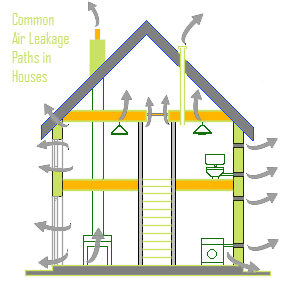
In April 2002, the UK government introduced air tightness testing alongside the Building Regulations law to enforce standards of dwelling air tightness. The legislation was created to lower running costs, verify the standards of materials, prevent uncomfortable drafts and avoid condensation problems. The air tightness test determines the amount of air leakage in cubic metres per square metre of the internal surface area of the building m3. Or, to put it simply, air tightness testing measures the amount of air that escapes through the gaps or building fabrics. Ideally, having an airtight building means that less energy will be wasted through the leakage of heated air. Air tightness testing is required for all new domestic and non-domestic builds, in addition to requirements detailed in Part L of building regulations sections 1A and 1B. Once tested (and the build’s air tightness quality improves) it will lower the environmental impact of the building as well as save the owner money on energy bills.
HOW DOES AN AIRTIGHTNESS TEST WORK?
To complete an air tightness test, access to an empty dwelling is required, Air testers install blower door testing equipment – essentially big fans – to an external opening like a doorway. They will then use it to pressurise the building and test over-pressure differences. The outer air pressure then flows in through the cracks and openings.
The fan will typically depressurise the house to a pressure of at least -60Pa. An anemometer will read the internal pressure, external pressure and the strength the fan has to work at to create the pressure difference. This will help to calculate the air leakage.
DO I NEED AN AIRTIGHTNESS TEST?
You should get airtightness testing companies in if there is a lot of heat escaping from your home. Heat escaping through tiny cracks and gaps in the walls can cost you hundreds of pounds a year, and thousands over a lifetime. An air tightness test is necessary if you want to pass building regulations.
HOW DO YOU PASS AN AIRTIGHTNESS TEST?
To pass an airtightness test you need to meet a target air permeability score. Every new building is given a score ranging from 1-10, which is considered possible for your building to meet. An SAP assessor gives you a score and we do our best to help you meet this target. The building work is only signed off once it has been met. Get an experienced air tightness technician to carry out this task for maximum reassurance. Click here for tips.